Research Article by a University of Kurdistan Faculty Member Published in the Prestigious International Journal Ageing Research Reviews
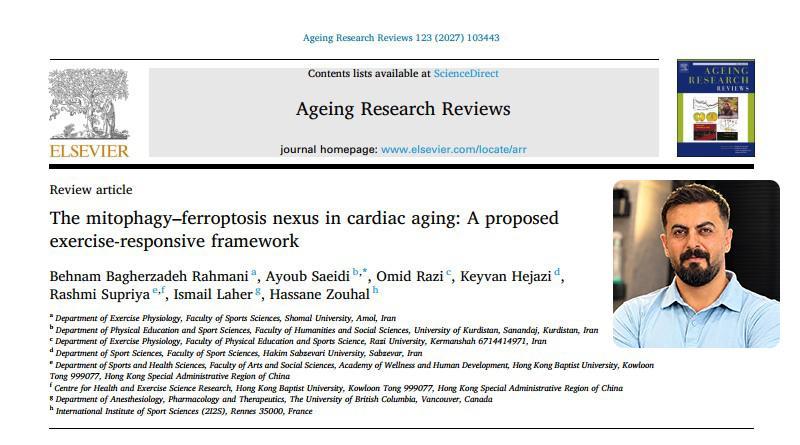



A research article by Dr. Ayoub Saeidi, a faculty member at the University of Kurdistan, focusing on the relationship between cellular mechanisms and the role of exercise in cardiac ageing, has been published in the prestigious international journal Ageing Research Reviews.
The research article was published in Ageing Research Reviews, an international journal affiliated with the renowned publisher Elsevier. The journal is regarded as one of the leading and most highly cited sources in the field of ageing research.
According to the 2025 Journal Citation Reports (JCR), the journal has an Impact Factor of 15.5 and is ranked in the Q1 category. Its CiteScore in Scopus reaches 24.1. The journal currently ranks among the top 2% of journals indexed in JCR and the top 1% of journals indexed in Scopus.
The published article, entitled “The Interplay Between Mitophagy and Ferroptosis in Cardiac Ageing: An Exercise-Responsive Proposed Framework,” presents an innovative conceptual framework to explain the relationship between mitochondrial quality control mechanisms, iron metabolism, and cell death in the ageing heart.
By examining the potential role of aerobic exercise in modulating the interactions among these cellular mechanisms, this research opens new perspectives on understanding the factors that contribute to maintaining heart health and reducing the vulnerability of cardiac cells during the ageing process.
The findings and theoretical framework presented in this article may provide a valuable foundation for designing future experimental studies in the fields of exercise physiology, cardiovascular health, and the biology of ageing.
Article Details:
-
Journal: Ageing Research Reviews
-
Publisher: Elsevier
-
Volume: 123
-
Article Number: 103443
-
Digital Object Identifier (DOI): 10.1016/j.arr.2026.103443
-
Access Link: View the full article
The University of Kurdistan recognizes and celebrates this scientific achievement and wishes Dr. Ayoub Saeidi and his research collaborators continued success in scientific advancement and international research.

Faculty Systems

Student Systems

Staff Systems

Virtual Tour

Telephone Directory

Privacy Policy Statement
Quick Links
Electronic Services
Useful Links

University of Kurdistan, Pasdaran Boulevard, Sanandaj, Iran

Postal Code: 6617715175

Phone: +988733664600-8

Email: info@uok.ac.ir


site visit
- today:
- yesterday:
- all:
Last Update
23 Nov 2026 - 07:19:59