
During the 1405 (2026) "Decade of Educational Excellence" meeting at the University of Kurdistan, the educational performance of the past year, the development of postgraduate programs, and educational plans and visions were reviewed and analyzed.
Review of the University of Kurdistan's Educational Performance and Future Horizons at the 1405 "Decade of Educational Excellence" Meeting
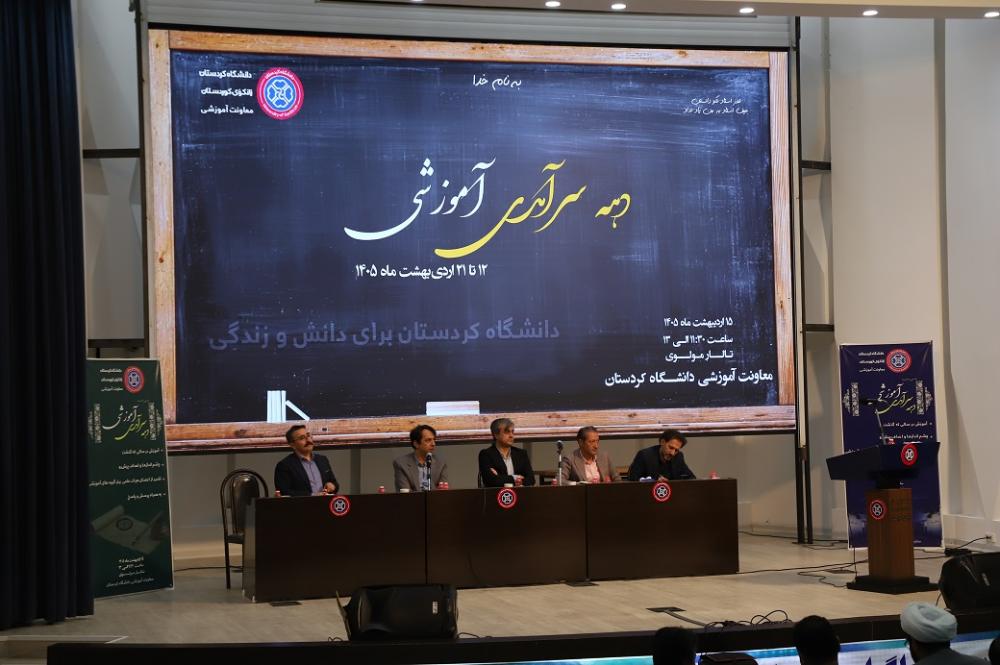



According to the Public Relations report of the University of Kurdistan; on Tuesday, May 5, the 1405 "Decade of Educational Excellence" meeting was held in the presence of faculty members. The session focused on reviewing the educational performance of the previous year, the progression of postgraduate program development, as well as the objectives, horizons, and forthcoming plans of the university's educational sector.
30% Growth in Doctoral Programs at the University of Kurdistan
At the beginning of the meeting, Dr. Adel Si-o-se-marde, President of the University of Kurdistan, announced the expansion of postgraduate programs at the university, stating: "In the current year, the number of doctoral programs has increased by more than 30 percent."
Congratulating Teacher's Day and expressing gratitude for the efforts of colleagues, Si-o-se-marde remarked: "Working under the current circumstances and through virtual education is significantly more challenging than face-to-face instruction, and the staff in the educational sector have undertaken great efforts during this period."
Referring to the university's educational activities, he added: "Significant measures have been taken in the field of education. Currently, approximately 20 new Master's programs and 3 new Bachelor's programs are under review to be added to the University of Kurdistan's educational portfolio."
The President of the University of Kurdistan continued: "In the postgraduate sector, we previously offered 30 programs, and in the past year alone, we successfully obtained licenses for 10 new programs. This represents an increase of over 30 percent in this field, which is a rare achievement in the country in recent years."
Adel Si-o-se-marde also touched upon the university's educational policies, noting: "It has been decided that, if necessary, virtual classes will be conducted from within the university."
Regarding the status of postgraduate students, he stated: "Limited dormitory access has been provided for certain postgraduate students who need to use laboratories or maintain direct contact with their supervisors; however, this does not signify a return to full in-person instruction."
39 Doctoral Programs are Active at the University of Kurdistan
Subsequently, Dr. Mohammad Razaghi, Vice President for Education at the University of Kurdistan, referred to the unique conditions of the past year and reported numerous challenges in conducting classes and examinations. He stated: "In the pursuit of maintaining educational activities, the university's educational sector has faced many ups and downs during this period."
In his remarks, he addressed the transition to virtual education in universities, stating: "This shift created numerous complexities and problems for the university; nevertheless, efforts were made to continue education with maximum capacity and available resources."
Razaghi added: "With the virtualization of university classes, a system was launched to facilitate better communication between students and the educational sector, allowing students to pose and follow up on their questions online."
Regarding future plans, he said: "The vision for the university's educational sector in 1405 is to enhance educational quality, create transformation in teaching, increase impact, realize educational justice, diversify programs, and move toward scientific authority and internationalization."
Highlighting innovative educational measures, Razaghi noted: "For the first time, several skill-based and practical courses, including 'Disaster Preparedness' (one credit) and 'Passive Defense' (two credits), have been added to the undergraduate curriculum, which were well-received by students."
The Vice President for Education further addressed program development, stating: "An admission capacity of 178 has been announced for the doctoral level, and currently, 39 doctoral programs are active at the university."
Emphasizing that establishing any doctoral program is a complex process, he added: "Various stages must be completed to obtain a license for each program, and the efforts of colleagues in this field are commendable."
The meeting concluded with a Q&A session where the attending professors shared their perspectives, suggestions, and critiques.


Quick Links
Electronic Services
Useful Links

University of Kurdistan, Pasdaran Boulevard, Sanandaj, Iran

Postal Code: 6617715175

Phone: +988733664600-8

Email: info@uok.ac.ir


site visit
- today:
- yesterday:
- all:
Last Update
06 May 2026 - 08:02:21